Jaw crusher
Product Overview:
The roller crusher (double roller crusher) is suitable for fine crushing operations with an input material size of less than 30 mm and a product size requirement of 3–20 mm. Applications include the artificial production of sand from materials such as pebbles and construction waste; fine crushing of iron ore and quartzite in the mining industry; and raw material crushing in the ceramic industry. It is widely used for primary and secondary crushing of brittle bulk materials in industries such as cement, chemical, electric power, mining, metallurgy, building materials, refractories, and coal mining. The crusher can handle large feed sizes, and the discharge size is adjustable. It is capable of crushing materials with a compressive strength of up to 160 MPa. Particularly in the coal industry, when this machine is used for crushing raw coal, it can perform crushing directly after iron and impurity removal, without the need for gangue removal. The crushed material has uniform particle size and a low over-crushing rate, thereby simplifying the coal preparation process and reducing investment and production costs.
Working principle:
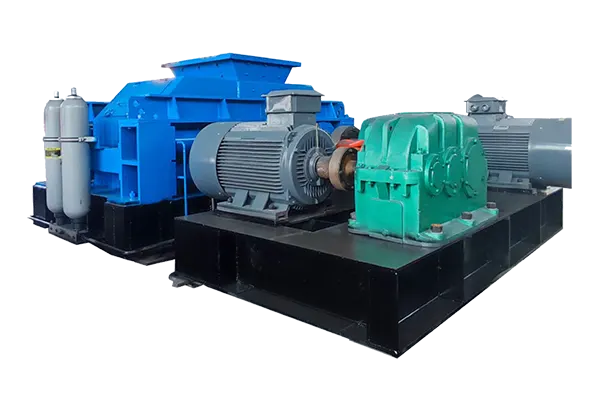
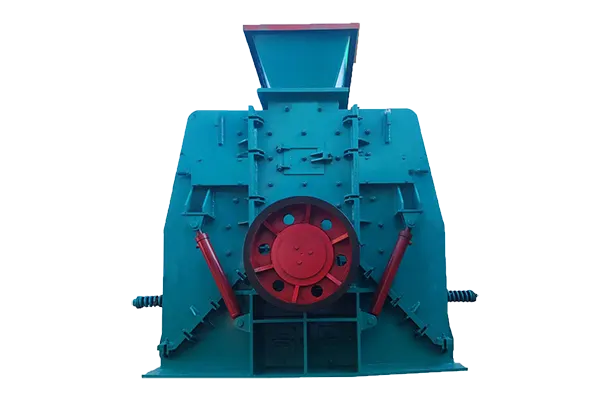
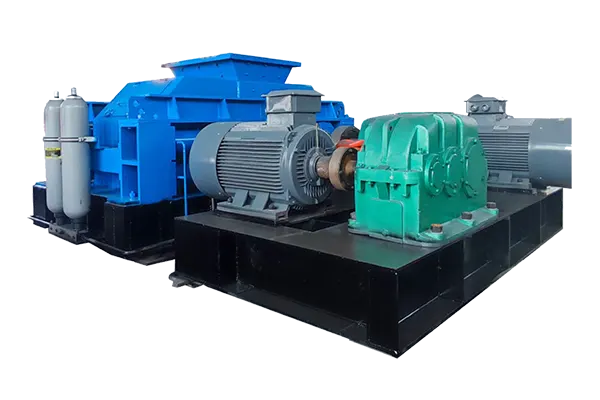
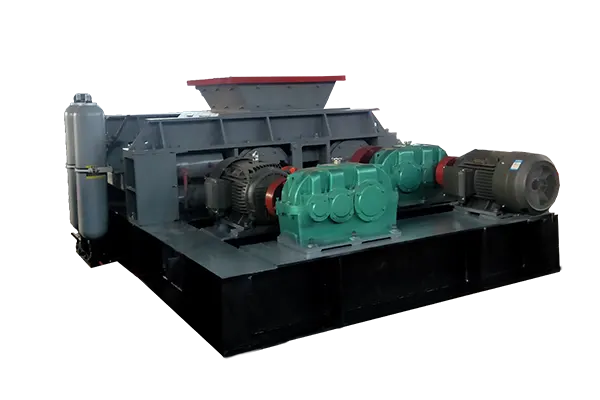
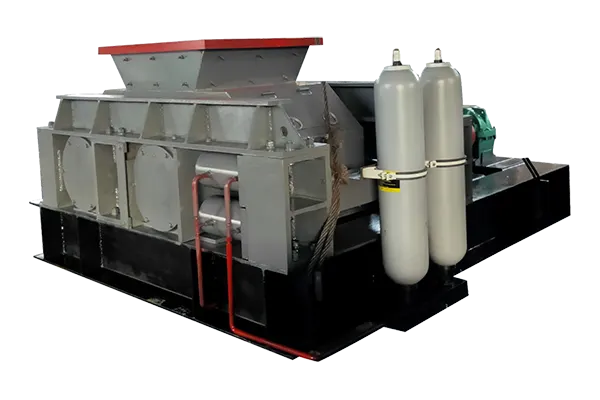
1. This series of double-roll sand making machines mainly consists of roll assemblies, roll support bearings, compression and adjustment devices, drive units, and hydraulic systems, among other components.
2. Adjustment of discharge particle size: Hydraulic cylinders and shim adjustment devices are installed between the two rolls. The shim device regulates the discharge particle size by increasing or decreasing the number or thickness of the shims. Adding shims widens the gap between the two rolls, while reducing shims narrows the gap, resulting in a smaller discharge particle size.
3. The drive mechanism is powered by two electric motors and transmission shafts, driving the rolls to rotate in opposite directions. During material crushing, the material enters through the feed port, passes between the rolls, and is crushed by compression. The crushed product is then discharged from the bottom of the frame.
4. For safety purposes, a protective cover should be installed on the transmission parts according to actual conditions.
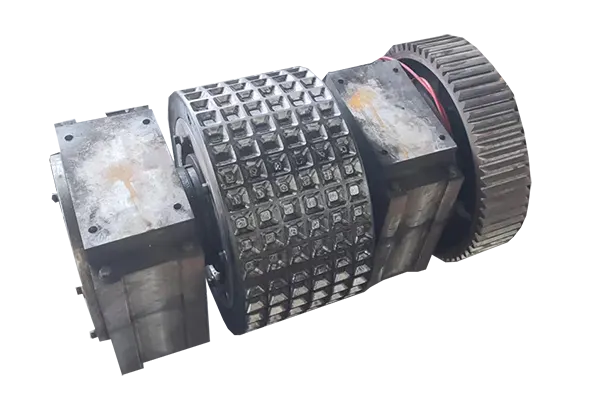
Each roll of the double-roll sand making machine is driven by an independent motor. The feed must be uniform to prevent localized wear on the roll surface. Smooth-surfaced rolls primarily crush materials through compression, accompanied by some grinding action, making them suitable for medium and fine crushing of materials with medium hardness.
Performance Features:
1. Equipping the grinding system with the PDG-II double-roll sand making machine allows the grinding equipment to achieve its full production potential, typically increasing output by 30%–40% while reducing total energy consumption by 20%–30%.
2. With its compact structure, light weight, and small footprint, the PDG-II double-roll sand making machine enables significant investment savings for grinding systems with the same production capacity requirements.
3. The machine features a simple structure, occupies minimal space, and is convenient to operate and maintain.
4. Equipped with built-in dust baffles and excellent sealing performance, it effectively prevents the scattering of fine crushed materials, resulting in reduced dust emissions, lower operating noise, and a significantly improved working environment.
5. The grinding rolls of the double-roll sand making machine are fitted with replaceable wear-resistant liners made of advanced domestic wear-resistant materials. These liners offer long service life, high durability, and easy maintenance. Their continuous service life can exceed one year. When severely worn, the liners can be replaced simply by opening the machine cover. The minimal maintenance requirements and low cost are unparalleled by any other type of domestic sand making machine.
6. The double-roll sand making machine is equipped with a safety protection device. In the event of accidental entry of metal foreign objects into the crushing chamber, the protection device activates, allowing the metal object to pass through while the equipment continues normal operation.
7. The roll gap of the grinding rolls in the double-roll sand making machine is adjustable within a range of 3 mm to 20 mm. After setting the roll gap according to the required crushing particle size, the output particle size is reliably controlled, with all materials discharged from the bottom of the crushing chamber at the ideal size.
8. The machine features a simple and rational structure, low operating costs, stable operation, high efficiency, energy savings, excellent crushing performance, and adjustable discharge particle size.
9. The double-roll sand making machine operates on the principle of low-speed, high-pressure roll compression. Material enters the crushing chamber vertically from the top of the machine and is crushed under the high pressure generated between the two rolls. Most of the material becomes powdery, while the remaining small fraction of granular material develops numerous internal cracks. During further grinding, this significantly reduces energy consumption and increases output.